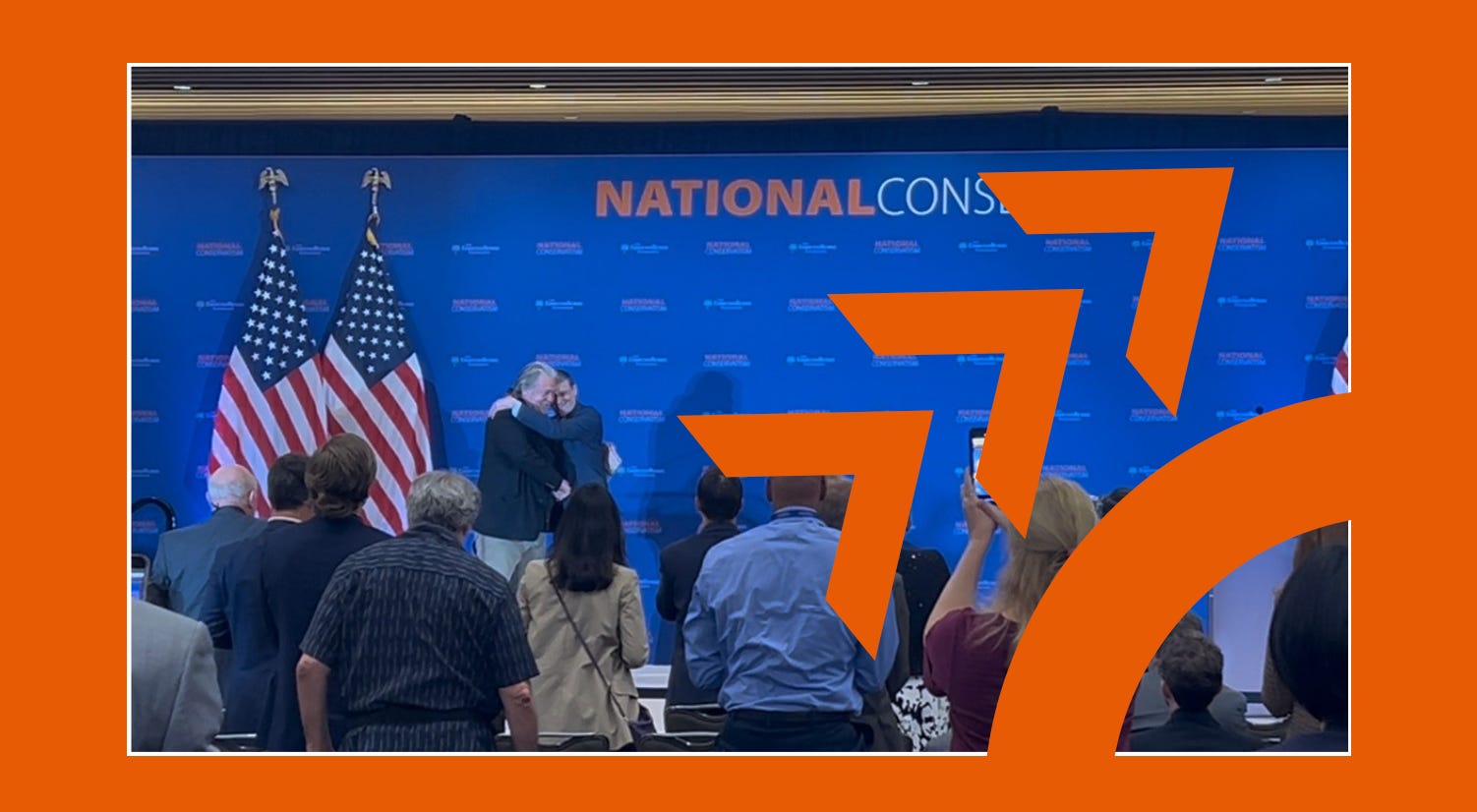
NatCon Day 1: What is National Conservatism?
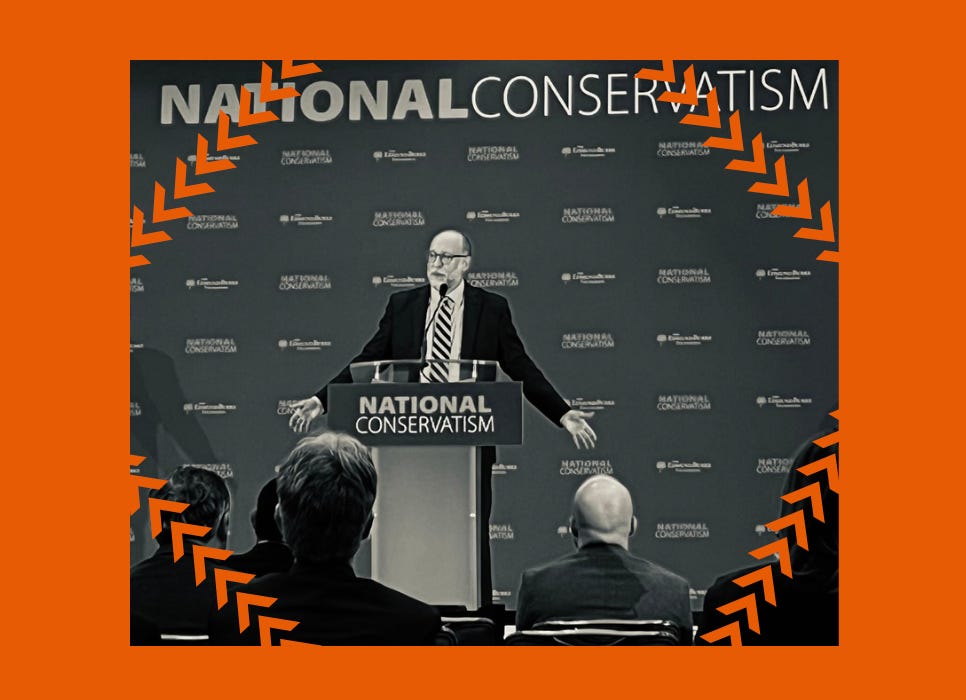
Members of The Review were invited to attend the 2025 National Conservatism Conference, or NatCon.
NatCon, once a gathering held on the fringes of the conservative movement, has grown into an important forum for many of the most influential decision makers of the current administration. To understand the issues raised at this conference is to understand those motivating the modern Republican Party.
In our three-part series, we hope to share the conference’s main takeaways.
We heard from speakers within the Trump Administration, prominent intellectuals, and popular journalists. This is what happened on Day 1:
First, we heard from the opening speakers:
Rachel Bovard (Vice President of Programs at the Conservative Partnership Institute, on the Board of NATCON)
Bovard spoke on the successes of the Trump administration, as well as gave a warning about the growing danger of transhumanism, which is a growing interest among Silicon Valley’s “tech right.”
Oxford Languages defines transhumanism as “the belief or theory that the human race can evolve beyond its current physical and mental limitations, especially by means of science and technology.”
Kevin Roberts (President of the Heritage Foundation)
Roberts spoke about the importance of the American family to policymaking. Statesmen must prioritize the nuclear family in their decision-making, utilizing prudence to provide the best possible scenario for the average American.
Yoram Hazony (Author of The Virtue of Nationalism, Chairman of NatCon)
Hazony spoke on the successes of the National Conservatism movement and how it needs to stay united in order to stay strong.
As a Jewish national conservative, he cautioned against the growing divide between pro- and anti-Israel conservatives in the movement. He feared that a potential rise in antisemitism on the right would fracture the national conservative coalition.
The conference then broke into 3 concurrent panels:
“The Threat of Islamism in America”
Eric Teetsel (Chair)
Nathan Pinkoski
Jim Hanson
Ryan Girdusky
Wade Miller
“The President Vs. the Courts”
Inez Stepman (Chair)
James Burnham
Josh Blackman
Ted Frank
Ron Coleman
“AI and The American Soul”
Amber Duke (Chair)
Wynton Hall
Geoffrey Miller
Spencer Klavan
Jeffrey Tucker
We attended “The President Vs The Courts”, where we heard from Josh Blackman about how lower courts of the United States are currently fighting against the decisions of the Supreme Court and the Executive Branch. Other speakers emphasized the need for an energetic executive, the future of nationwide injunctions after Trump v. CASA, and the political biases that may motivate judges on the bench.
Then, we heard from the next panel of Plenary speakers:
Larry Arnn (President of Hillsdale College)
Arnn spoke on the importance of a liberal arts education in politics, as well as the merits of a Christian nation.
Sen. Eric Schmitt (Senator of Missouri)
Senator Schmitt spoke about what it means to be an American, declaring that Americans have a unique pioneer culture and identity, and they must be wary of being ashamed of their history.
Tom Klingenstein (Chairman of the Claremont Institute)
Klingenstein gave a speech about the dangers of “white guilt” and how America must “move on” from the darker sides of its past so that it can pursue a better future, unburdened.
Rep. Riley Moore (Representative of West Virginia)
Representative Moore emphasized the importance of American industry and how America must once again become a producer nation to have a competitive edge against the Chinese economy.
Breaking into panels again, we had the option to attend:
“Immigration Law”
Ryan Neuhaus (Chair)
Will Chamberlain
Bill Shipley
Ben Badejo
Ilan Wurman
“America and the Israel-Iran War”
Daniel McCarthy (Chair)
Curt Mills
Max Abrahms
“The Need for Heroism”
James Orr (Chair)
Shyam Sankar
Helen Andrews
Alex Petkas
R.R. Reno
We attended the “America and the Israel-Iran War” panel, witnessing a fiery debate about the place Israel has in America’s foreign policy. The intra-movement split illustrated a stark divide between older and younger conservatives in the movement.
Curt Mills, the millennial Executive Director of The American Conservative, represented an Israel-skeptic viewpoint against the more traditionally pro-Israel Max Abrahms, a Generation X associate professor at Northeastern University.
Finally, we attended a conference dinner, where we heard from:
Harmeet Dhillon (The Assistant Attorney General for Civil Rights at the U.S. Department of Justice)
Dhillon spoke on the many successes she has achieved during her term, such as dismantling DEI and tackling the issue of transgender people in athletics.
Summary:
The first day of NatCon included discussions on the American identity, economic policies, transhumanism, foreign policy, and religion. They embodied the efforts of an early movement to determine its future identity, policy priorities, and longevity in American politics. The movement contended with uneasy factional divides, both between traditional national conservatives and the tech right, and between older and younger conservatives over the support of Israel.
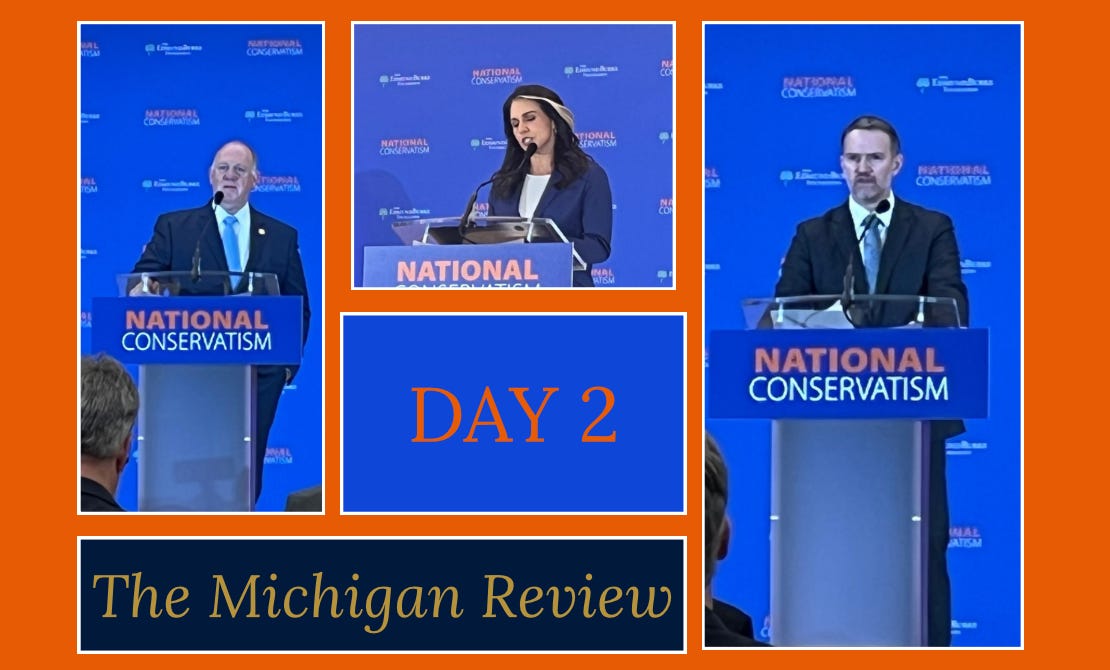
We then prepared for Day 2, where we’d hear from names like Tom Homan, Russ Vought, and Tulsi Gabbard!
Disclaimer: All takeaways were gathered from on-the-record speeches made by the conference’s speakers.
About the Author
Luca Desanto is the Lead Campus Reporter for The Michigan Review. He is an undergraduate at the University of Michigan, an analyst at Ascent Consulting Group, and the Business Officer of Michigan Men's Rugby.