Beyond the Blue Tsunami
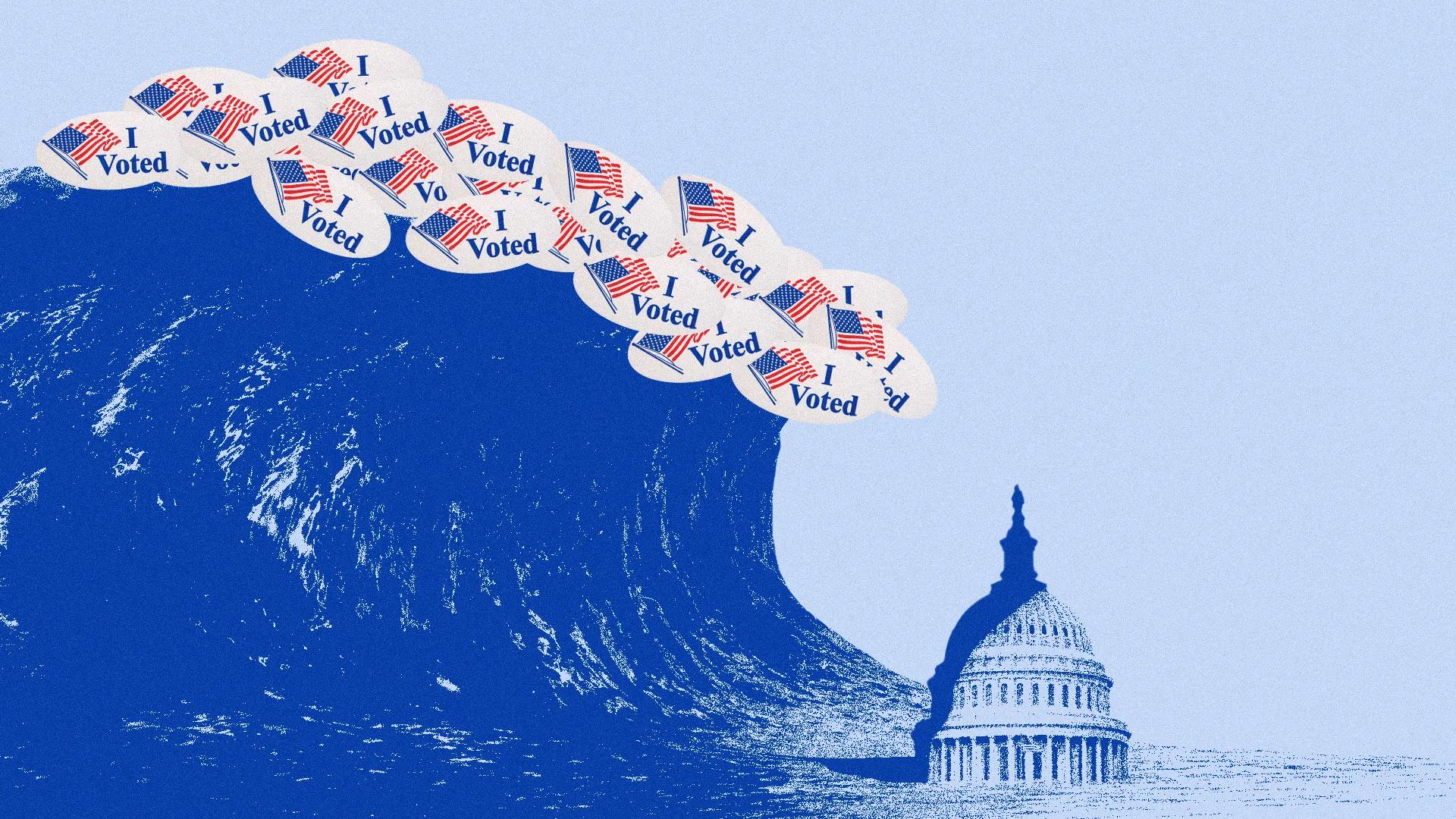
Earlier this month, we witnessed perhaps the largest pendulum swing since Watergate: voters all across the country voted in favor of drastic administrative change. In January, the Democrats will control both chambers by staggering margins, flipping 8 seats in the Senate and 42 in the House. It is clear, across the country, that voters are fed up with the current administration, especially when considering the economy and war in the Middle East. States where President Trump won in double digits two years ago, such as Texas, South Carolina, and even Kansas—which hasn’t had a democratic senator since 1932—flipped blue this election.
So what does this say about both the democrats and republicans moving forward? For the republicans, this is a difficult, but far from unexpected loss. Coming up to the election, Trump campaigned in deep red states and counties where republicans had extensive support. Oddly, instead of bolstering the candidate running in that area, Trump spoke mostly about himself. Considering his current approval rating sits at around 32%, this was not a smart campaign strategy. On November 2, the day before the election, Trump spoke at length about how he envisioned renovating the reflecting pool, instead of urging voters to get out to the polls.
Taking a closer look at Michigan, Abdul El-Sayed emerged victorious as the first Muslim US senator, winning about 52% of the votes. What’s arguably most impressive about his win was the sheer fiscal disadvantage he faced heading into the final weeks, first being outspent by Haley Stevens 8 to 1, then Mike Rogers. I covered this before the midterms.
But something changed in the final days leading up to the election: Haley Stevens, in an act of career suicide, revoked her endorsement of El-Sayed and backed the GOP. She said in a video on social media two days before the election, “Who we are as Michiganders is not hate, and it is not what we are getting out from our Democratic nominee right now.” This was a betrayal of enormous proportions to the Democratic Party: one high-ranking Senate Democratic aide anonymously commented: “Haley swings no votes at this point. She just lit her career on fire for no reason.” Indeed, this likely had very little effect on the election, since many of the ballots were already in at the time of her endorsement, and the El-Sayed campaign reported over $2.4 million in donations, the best fundraising day of the entire campaign. It seems her endorsement of Rodgers may have actually helped El-Sayed—a career-ending backfire.
When it came to ballot proposals, Michigan voters were extremely certain about what they wanted. Over 70% of voters voted “no” on proposal 1, and more than 80% voted in favor of Proposal 2. Proposal 1 would have organized a convention to discuss revisions to the current state constitution—which is required to appear on ballots every 16 years according to the current state constitution—while Proposal 2 would have inhibited government contractors and associated individuals from donating unrestricted funds to campaigns and expanded campaign finance disclosure requirements. Proposal 2 was an extremely contentious and ambitious proposal; on the day of the election, the Mackinac Center filed a lawsuit claiming the proposal violated the First and Fourteenth Amendments of the U.S. Constitution and was a “dangerous assault on the right… to hold [the] government accountable.” While I see the value in some of these arguments, I—and evidently the majority of Michiganders—believe that our political system would benefit immensely from a more regulated campaign finance system.
Overall, this midterm tells us a few important things: one, Michiganders are generally against money in politics. Abdul El-Sayed’s campaign and the incredibly popular Proposal 2 aimed to regulate and restrict the campaign finance system, which will likely be the cause of much debate down the line. Two, the public is done with Trump, republican voters included. If the Republicans want a shot at retaining the West Wing, come 2028, they need a strong candidate who sits much more centrally and much less Trump-like. President Trump brought an immense personality into politics which contributes to his intensely loyal and almost cultish following. I expect a similar personality will vie to take his place at the head of the Republican Party, while trying to remain distant from Trump himself.
Democrats also should take warning of Trump's unpopularity: with their majorities in both chambers, it seems enticing to investigate Trump thoroughly, searching for an impeachment. However, battling Trump would only add to the anti-Trump identity they’re associated with, an unpopular identity that got Trump elected in 2024. The outpouring of the “blue tsunami” is not a permanent bid of support for the democrats: as a whole, the party is still viewed poorly, with only 4 in 10 voters viewing the party favorably. Ultimately, both parties need to put Trump behind them: the democrats should leave him alone and let him live out his last two years in the Oval Office, and the republicans should start rigorously reflecting on a new direction for the party, one which does not include Trump.
As a centrist, this election brings me hope, not because the democrats won so resoundingly, but because it can finally push our country back towards the center of the political spectrum. Regardless of what you think of President Trump and his policies, he has radically changed the presidency: he’s made it more aggressive, introduced mudslinging at a level we have never seen before, and contributed to the enormous polarization currently plaguing our country. As we move forward and our country adapts, I’m hopeful that instead of moving farther and farther left or right in order to create a deeper, more dangerous divide, we move closer to where most voters actually lie. The voters have cast their support; it’s up to our representatives to justify it.