Robert Doar on the Midterms, 2028, and Why Your Vote Matters
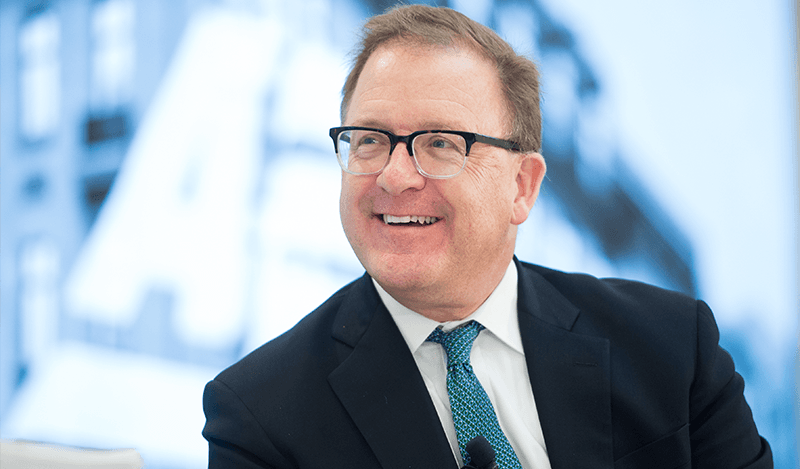
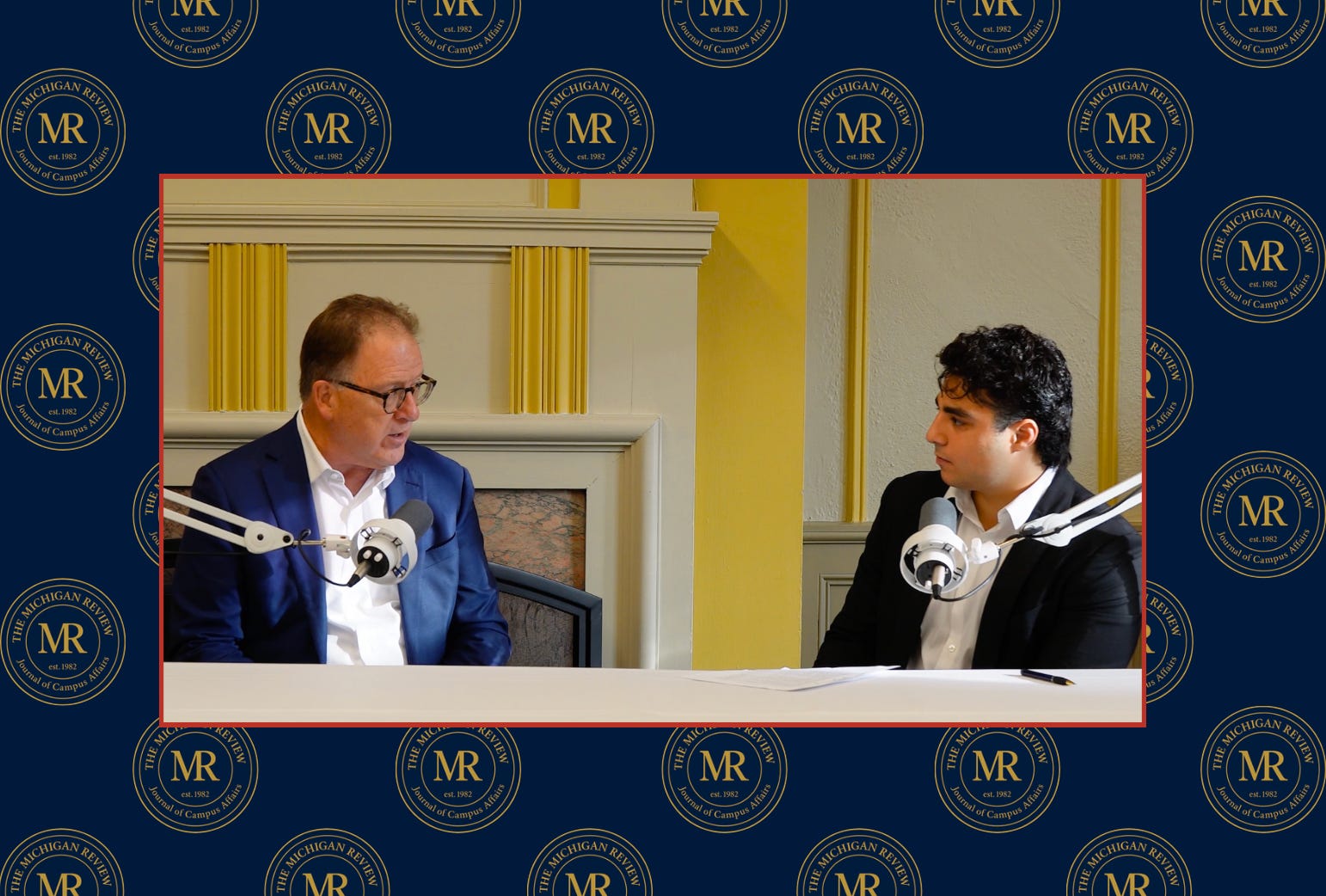
Just a few days ago on a beautiful Ann Arbor fall afternoon, Robert Doar, president of the American Enterprise Institute (AEI), came back to campus to talk with The Review. A year after his first visit, the conversation ranged from Ukraine to Michigan's Senate race to the shape of American politics after 2028. Underneath all of it ran a simple theme: the system works only if people take part in it, and tomorrow is the moment to do that.
“American democracy at work”
Asked what he expects from the midterms, Doar skipped the predictions. “I'm not a prognosticator,” he said, and he doesn't study every poll. What he does expect, and hope for, is “American democracy at work, elections all across America.”
He urged people to appreciate the process itself: the door knocking, the campaigning, the voters showing up. “Lots of parts of the world don't do that,” he said, pointing to China and Russia.
The contrast he drew is important. The V-Dem Institute at the University of Gothenburg counted 92 autocracies and 87 democracies at the end of 2025, and estimates that about 74% of the world’s population lives under autocratic rule. Its 2026 report also stresses that holding elections does not guarantee democracy, since non-democratic regimes increasingly stage votes whose outcome is known in advance. So don’t take what we have for granted.
When the votes are counted, he said, both sides should accept the result. People on either side who try to “use some legal jujitsu to argue against the will of the people” should be defeated, he said. “Let's go forward with who's elected and solve problems and move on.”
That point matters most to students. Elections are decided by the people who show up, and the stakes below the national headlines are real. Doar noted that if you look past the noise, “there's actually quite a lot of bipartisan and non-partisan activity in government where it doesn't matter what party you are,” from city management to federal agencies. As a former official under Governor Pataki and Mayor Bloomberg, he worked with Democrats all the time. “I'm not one of those Republicans that thinks that all government jobs are bad.”
Where the races stand right now
The national numbers heading into Tuesday are lopsided. In the final PBS News/NPR/Marist poll before Election Day, Democrats led by 8 points among likely voters in the race for Congress, President Trump’s approval stood at 38% among registered voters, and likely voters said by a 2-to-1 margin that their ballot is a vote against the president rather than for him. Michigan’s Senate race is closer. A WDIV/Detroit News poll by the Glengariff Group, conducted Oct. 19–22, had Democrat Abdul El-Sayed ahead of Republican Mike Rogers 51.4% to 45.1% among 600 likely voters, with a 4-point margin of error, and a YouGov poll reported Sunday had it 51% to 47%.
What voters should ask
With both Michigan Senate campaigns focused on health care, I asked what voters should demand of candidates who promise to expand or protect Medicare and Medicaid. Doar offered a single test: Will your plan make the cost of health care worse for the federal government? Medicare and Medicaid, he said, are “the two biggest drivers of our debt and deficit problem.”
The federal numbers show his rationale. The Congressional Budget Office projects that spending on federal health care programs will grow from $1.9 trillion in 2026 to $3.1 trillion in 2036, and the Committee for a Responsible Federal Budget estimates that health care accounts for about 30% of all projected spending growth through 2036.
Furthermore, he was skeptical of the Democratic Senate candidate Abdul El-Sayed's platform message: “money out of politics, money in your pocket, and Medicare for All.”
The first, he said, is “a lovely wish, but it's very naive.” He elaborated “it goes against a long history in America” where “there's money on both sides of politics”. The second made him nervous if it meant more federal checks that could undermine “the incentive to work” or to “earn your own success”. This is something Doar worked on for 20 years, renaming New York City’s ‘income maintenance centers’ to ‘job centers’, part of what led to beneficial outcomes for the people of the city. On the third, he argued that the parts of health care already run by the government “aren't run well” so put simply “why would we want to make more of them be run by the government?”
Additionally, anti-Muslim discrimination complaints sit at record levels. The Council on American-Islamic Relations logged 8,683 complaints nationwide in 2025, the most since it began publishing its annual report in 1996, and its Michigan chapter received 495 complaints, up 25% from the year before. Those are complaints reported to an advocacy group rather than a count of crimes, so they are an imperfect gauge, but nevertheless striking.
When asked about anti-Muslim rhetoric in a state with one of the country's largest Muslim populations, Doar was direct: “Stick to the issues. Stick to the policies, stick to what they say,” rather than religion, background, or immigrant status. This echoes traditional conservative values that caution against fixating on identity.
Looking toward 2028
Doar doesn't expect the parties to transform when Trump leaves the stage. “Most things are pretty much the same over time,” he said. He called Trump “very unique” and said he doesn't see anyone like him coming, though “there'll be another charismatic leader” in either party eventually.
He sketched the two sides this way: Republicans pair free-market capitalism and limited government with a cultural conservatism that is patriotic, skeptical of racial preferences and supportive of family and faith, while Democrats stress collective values and a belief that government can solve problems. Both, he said, have “some merit.” What has changed is the Republican base, now “much less college educated and more working class,” but the mix predates Trump: “The Reagan Democrats were reflected in that.” Pro-growth tax policy and less regulation, he said, weren’t “uniquely MAGA” but “long-standing right of center positions,” and they won’t change when Trump leaves.
On the Democratic side, he said the candidate who would worry Republicans most is the one “closest to the center,” who can attract moderate voters. Speaking from the strategic perspective of the party, if Democrats nominate someone seen as extreme, he said, Republicans would think “good for them,” because now Republicans “can capture the center.” He singled out Sen. Jon Ossoff, who would be twice elected if he wins tomorrow, and noted that Presidents Clinton and Carter won as southern Democrats. Ossoff goes in as the favorite: a late-October poll of likely voters had him ahead of Republican Rep. Mike Collins 48% to 40%.
Doar also said Vice President Vance starts with a big advantage as the incumbent party’s vice president. Sabato’s Crystal Ball notes that since 1953, all four sitting vice presidents who sought the presidency after the incumbent retired (Nixon, Humphrey, George H.W. Bush and Gore) won their party’s nomination. Only Bush went on to win the general election, though; the other three lost close races. Early polling fits the nomination story. A New York Times/Siena poll in October found Vance at 33% and Secretary of State Marco Rubio at 23% among likely Republican primary voters. Doar said the campaign will show where Vance falls between Trump, free-market conservatives and national populists. “We’ll find out,” he said.
If he could get any 2028 candidate to commit to one policy, his answer was immediate: “Debt and deficit.” He wants a commitment to “a trajectory that we can afford.” He said it may not be what candidates campaign on, but it’s what the country needs. The CBO’s long-term projections have federal debt held by the public reaching 175% of GDP by 2056.
Instability across the globe
His second worry was abroad: wars in the Middle East and Europe and tension in Asia “not only caused by China, but also by North Korea.” The country’s national security strategy “needs some work,” he said, built on the understanding that “we can’t do it alone” and on “coalitions of free thinking countries” to counter China, Russia, North Korea and Iran. He credited Trump with pushing European and Asian allies to spend more on their own defense, but said Trump has also “pushed them away,” leaving alliances that are “a little tattered and troubled” for the next president to rebuild. That is “a little bit of a criticism of President Trump for sure,” he said, and one most AEI scholars share. Getting the deficit in order, he added, would make the country “even stronger.”
After a June trip to Eastern Europe, Doar said his view had shifted a little on the war in Ukraine. He still doesn't buy the argument that if Ukraine falls, “the next thing it'll be Germany.” But in Moldova, President Maia Sandu told him, “Here I am on the front lines of the fight for freedom in Europe,” and that changed his thinking about the smaller countries on Russia's border. A Russian win in Ukraine, he said, puts them “more at risk.”
Moldova, a tiny country just west of Ukraine, would in effect be the next country in line, he said, and a Russian attack on it would be a bully going after a tiny country. “That’s what we ought to stand up against,” he said.
He also suggested the 2026 post-election lame-duck session could be a turning point, if victorious Democrats and Republicans critical of the president's stance on Ukraine join to “force him to get a backbone in the fight against Russia.” The timing matters, he said, because sanctions are at risk and “support for Ukraine is up in the air.” Once the election is over, he argued, members of both parties are freed up to act, and he called it “a very interesting thing to watch.”
Why read the other side
Doar was upbeat about campuses, which he called one of the achievements of the Trump administration and the broader conservative world over the past decade. He credited university presidents who have acknowledged fault, citing Yale, which he said issued a report admitting mistakes, and he said pressure from the administration and Education Secretary Linda McMahon helped. He said he sees more “willingness to speak up” in the students who come through AEI, “from both sides.” To audiences who worry that presidents will revert to old habits under a Democratic administration, he says he hopes not and doesn’t think so.
When I asked why diverse expression matters, his answer was about more than politics: “You don't get smarter by knowing only what you know and reading only what you think. You get smarter by reading what the other guy thinks, and you have to be willing to recognize that the other side may be right.” He said he reads both National Review and the New York Review of Books.
That advice applies to this election as well. Doar and I may disagree, and so will readers, on plenty of what he said. That is the point of reading it.
Go Vote
No matter which of these arguments persuades you, you can't weigh in unless you vote. Tomorrow, November 3, is Election Day. Check your registration and your polling place with the Michigan Secretary of State at michigan.gov/vote, and look at the full ballot, not just the Senate race.
The themes Doar raised will outlast this election: debt, health costs, America's role abroad, democratic process, party values. They'll shape the next few years, the 2028 campaign and well into the future. You get a say in how they play out, but only if you show up.