The "AI Slop" Epidemic and What We Can Do to Stop It
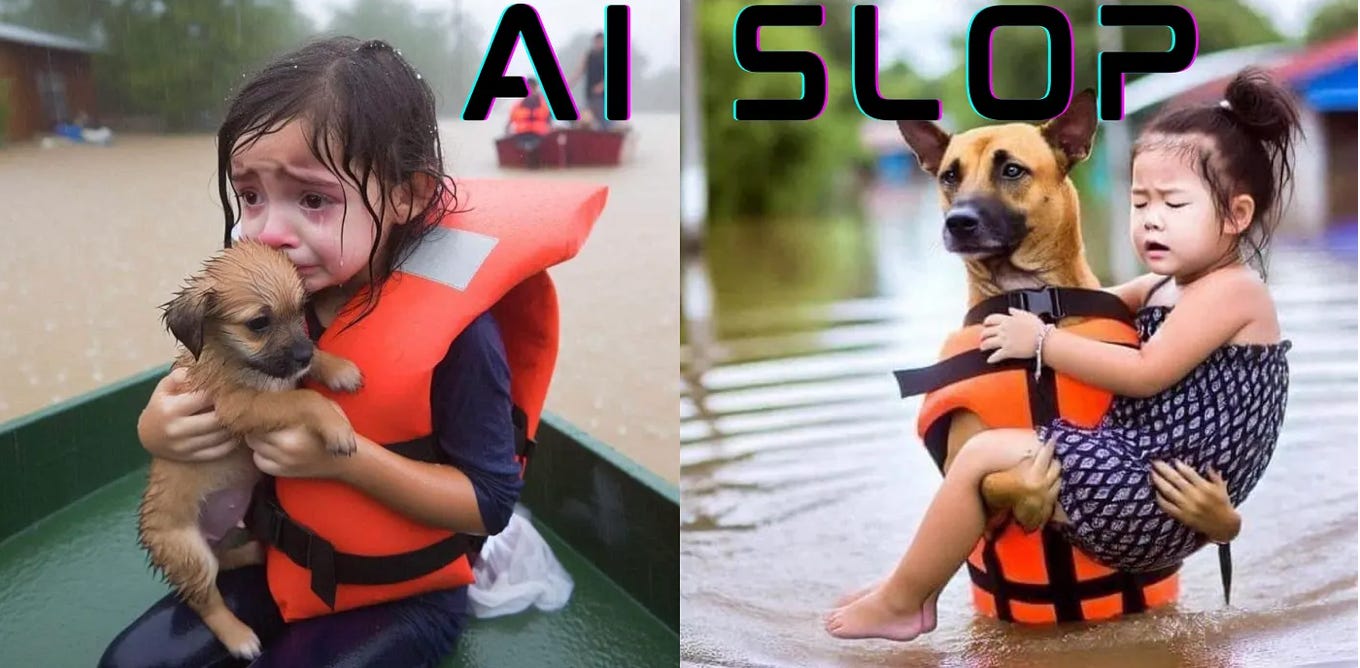
You get home from a long day of school. You pick up your phone, which your generation spends an average of over 6 hours on daily. You open up Youtube, or Instagram, or TikTok and…scroll. And scroll. And scroll some more. And scroll so much that your brain feels fried. Eventually, you come across a peculiar video. It looks funny at first, but feels unnatural. The voices are a little too robotic, and the images are a little too shiny. Most likely, it’s what Merriam Webster defines as brainrot: “mindless digital content; the fixation on it and harmful mental effects of it.” However, as you open the comment section, you are met with a gif that says “Your AI Slop does not amuse me.” With that, comes a haunting realization: you just watched something made completely by AI.
This new wave of AI-generated content has taken over social media. As of March 2025, 71 percent of all social media content was created by AI. This year, some experts expect that the number will skyrocket to 90 percent. The “Dead Internet Theory,” the idea that a vast majority of all online content will eventually be created by AI, has already become a reality. With that, a new, sickening genre of content has begun to take over. It’s called “AI Slop.”
AI Slop is defined as “low- to mid-quality content…created with AI tools, often with little regard for accuracy.” Entire channels produce AI Slop, with one in India called “Bandar Apna Dost” accruing 2 billion views–equivalent to over $4 million for the “creators.” To someone that’s chronically online, it is clear that this content is not real. However…it is an epidemic far worse than it may seem. Not only have some channels become disgusting production factories, but AI Slop has become analogous with scams on the web. One scammer will make 200+ AI slop websites in one go. Research has shown that the ability to detect AI declines dramatically with age, leaving the elderly particularly at risk.
The impacts of this are clear. The internet, once a vibrant sphere for creative expression, has now become a cesspool of low quality, low effort, slop. When we once had to debrief our grandparents about internet scams made by humans, we now have to explain what AI is to them…knowing our advice is falling on deaf ears.
It is to this writer’s opinion that within the next five years, 99.99% of content on social media will be AI generated. It’s a pure numbers game. There are channels pumping out 100s of videos a day as I write this very article. As someone that values art and creative expression, this is a nightmare come true. In five years…how will we be able to tell what art is human-created and what uses AI? Not only will it become next to impossible, but the fact that that is a question that will have to be asked is terrible.
So, what do we do? There is a silver lining: humanity has not taken a liking to AI Slop. Far from it. As alluded to in the introduction, almost every comment section under AI created posts is filled with disapproving viewers. Even more than that–people are starting to actively seek out non-AI content. As a result, there has been a creative revolution. Content that’s flawed, messy, and human is now in high demand. Leaning into our own humanity is how we must revolt against AI. And in a way, that’s beautiful.
Watch hand animated movies. Read poetry. Support real causes, not computer generated “people” on a screen. By giving our attention and money to things that are real, we signal to companies that producing real products is what is most profitable for them. Beyond that…we signal to society at large that we will take a stand against AI.
Basically, be human. The rest will follow.